Thom Yorke
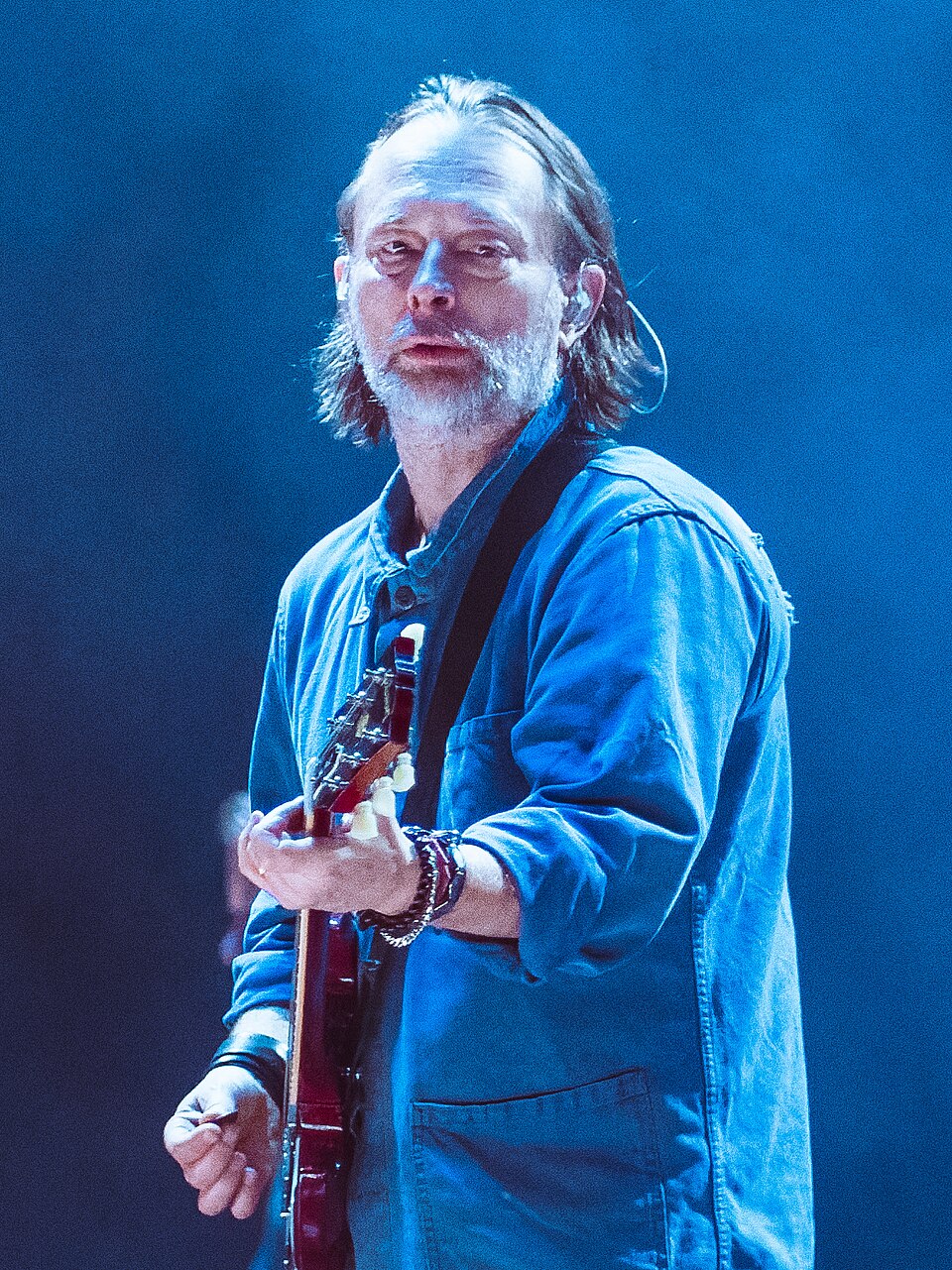
The singer whose anxiety became the century's anxiety, and whose band turned the fear of obsolescence into some of the most technically ambitious rock music ever made.
Thom Yorke has spent three decades as the primary songwriter and singer of Radiohead, building a body of work that moved from guitar rock to electronic abstraction and back without losing the emotional core that made him difficult to ignore. As a solo artist and collaborator he has continued to explore the territory between composed and electronic music, between singing and processing.
Early life and Radiohead's formation
Born in 1968 in Wellingborough, Northamptonshire, Yorke was partially blind in his left eye from birth — a condition corrected through a series of operations in childhood. He formed the band that would become Radiohead with schoolmates at Abingdon School in Oxford during the mid-1980s. After studying English and Fine Art at the University of Exeter, he returned to Oxford to commit to the group. Radiohead's debut Pablo Honey (1993) produced the inescapable single "Creep," which Yorke has had an ambivalent relationship with ever since — a song he reportedly came to resent for overshadowing the work he considered more representative.
The defining records
The arc of Radiohead's output from The Bends (1995) through OK Computer (1997), Kid A (2000), and Amnesiac (2001) constitutes one of the more sustained streaks in late-twentieth-century rock. OK Computer — Yorke's anxious survey of technology, alienation, and late capitalism — was voted among the greatest albums of its era by numerous publications. Kid A abandoned guitar rock almost entirely for electronic textures influenced by Krautrock, jazz, and avant-garde composition; its release without lead singles or conventional promotion was a deliberate rupture with industry norms. The album reached number one in both the UK and the United States.
Yorke's lyrics in this period worked through fragmentation and elision rather than narrative, creating a language that felt both private and universally applicable. His falsetto — piercing and unguarded — became one of the most recognisable voices in contemporary music.
Solo work and collaboration
Yorke's first solo album, The Eraser (2006), developed the electronic interests of his Radiohead work in a quieter, more introspective register. Subsequent solo projects — Anima (2019), accompanied by a Paul Thomas Anderson short film — continued in this direction. He has collaborated extensively with producer Nigel Godrich, his long-time partner in and outside Radiohead. He composed the score for Suspiria (2018), Luca Guadagnino's horror film, released under the name Thom Yorke Tomorrow's Modern Boxes.
| Album | Year | Format |
|---|---|---|
| The Eraser | 2006 | Solo |
| Tomorrow's Modern Boxes | 2014 | Solo; BitTorrent release |
| Anima | 2019 | Solo |
| Suspiria | 2018 | Film score |
Legacy and stance
Yorke has used his public profile to advocate for action on climate change and to criticise the economics of the streaming era. He and Radiohead briefly removed their catalogue from Spotify in 2013 in a dispute over royalty rates. His influence on subsequent artists — in rock, electronic music, and the hybrid spaces between — operates through both sound and attitude: the idea that a commercially successful band need not simplify, and that anxiety is a valid artistic subject rather than a problem to resolve.
We live in a world of total distraction, and we're all playing along. I'm not sure that's sustainable.