Wolfgang Amadeus Mozart
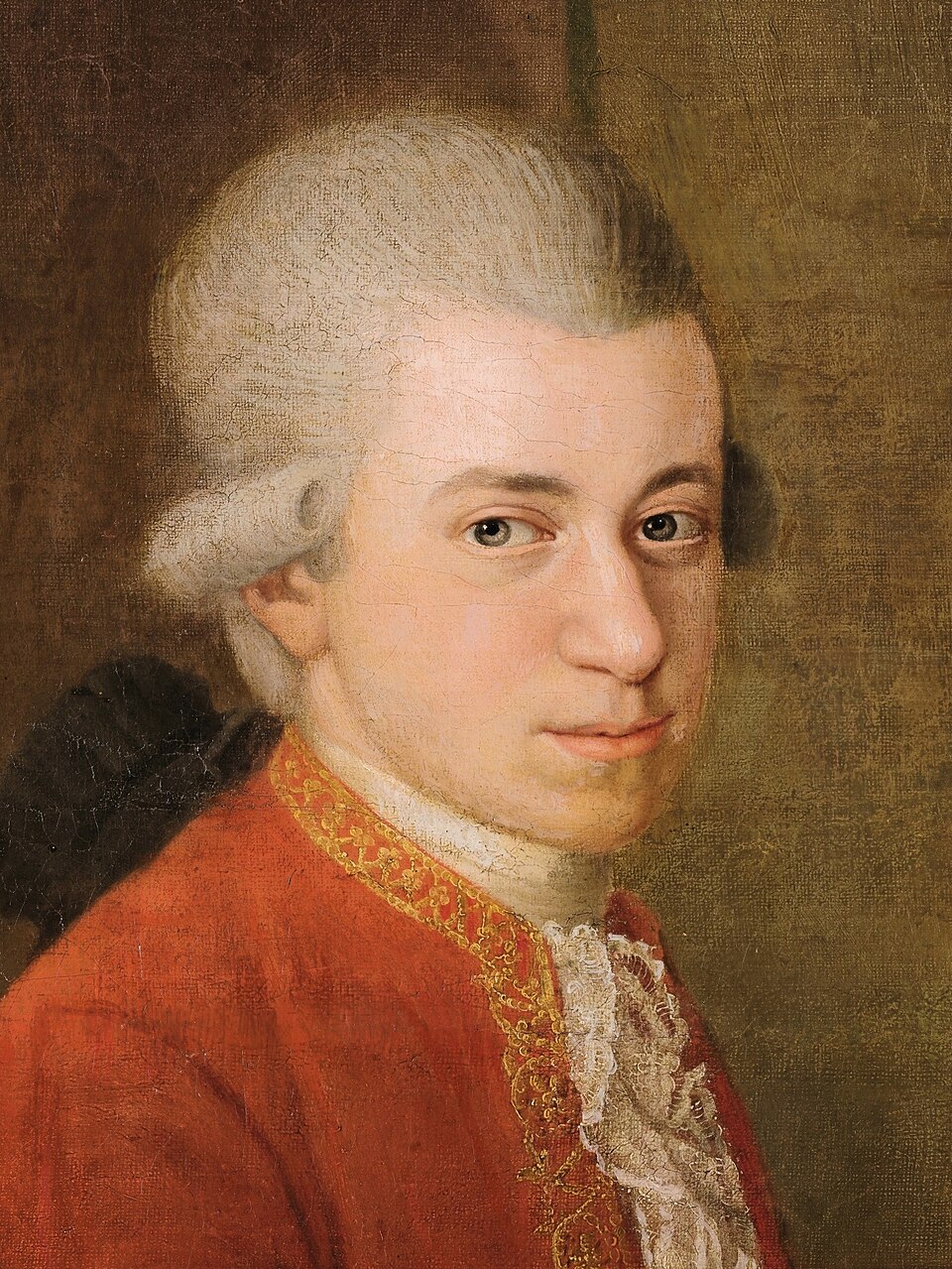
An Austrian composer of the Classical era whose fluency across every form of his day — opera, symphony, concerto, chamber music — set a standard the tradition has measured itself against ever since.
Wolfgang Amadeus Mozart was a child prodigy who became one of the most productive and influential composers of the Classical era. From the age of six he toured the courts of Europe with his father Leopold — his teacher — and his sister Nannerl, absorbing the styles of every place he passed through before dying in Vienna at thirty-five, leaving his Requiem unfinished on the desk.
The touring child
Born in Salzburg in 1756, Mozart showed extraordinary musical ability almost as soon as he could reach a keyboard. His father Leopold Mozart, a violinist and composer at the Salzburg court, took over his son's education entirely, and from the age of six paraded the boy and his older sister Maria Anna ("Nannerl") through the courts of Europe as touring prodigies. The journeys — to Munich, Paris, London, and beyond — exposed the young Mozart to the leading musicians and idioms of the age. What began as exhibition became apprenticeship: he was composing seriously in childhood and assimilating the styles he encountered into a musical language of his own.
Vienna and the great operas
Mozart's mature genius found its fullest expression in opera. Working with the librettist Lorenzo Da Ponte, he produced three of the central works of the operatic repertory: The Marriage of Figaro (1786), Don Giovanni (1787), and Così fan tutte (1790). In these works comedy, character, and musical structure fuse so completely that the drama seems to think in music. His final opera, The Magic Flute (1791), blended popular comedy with solemn ceremony and proved an immediate success in the last months of his life.
Symphonies, concertos, and range
Beyond the opera house Mozart wrote across every instrumental form of his time. In 1788 he completed his last symphonies, including Symphony No. 40 in G minor and Symphony No. 41, the latter nicknamed the "Jupiter" for its grandeur and its masterly contrapuntal finale. He was also the pre-eminent composer of the piano concerto, writing numerous works in the form — among them No. 20 and No. 21 — that established the concerto as a vehicle for symphonic drama rather than mere display. The full breadth of his output is charted by the Köchel catalogue (K.), the standard chronological index of his roughly 626 works.
The unfinished Requiem
In 1791, the year of The Magic Flute, Mozart received an anonymous commission for a Requiem in D minor. He was still working on it when he died in Vienna on 5 December 1791, aged thirty-five. The score was left incomplete; at the family's request it was finished by his pupil Franz Xaver Süssmayr, and the circumstances of the commission and completion have fed speculation ever since. The Requiem, sombre and unfinished, has become inseparable from the image of a composer cut off at the height of his powers — though the works he did complete already amounted to one of the most comprehensive achievements in Western music.
Trained from infancy and travelled across a continent before he was ten, Mozart turned a childhood of exhibition into a command of every musical form his century possessed.